5G Home Internet : Everything You Need To Know
5G Home Internet: Everything You Need to Know
There’s a newer option sitting alongside fiber and cable on most comparison sites, and it works completely differently from both: 5G Home Internet. No cables run to your house, no technician installation appointment, and setup that genuinely takes minutes instead of days. Here’s how it actually works, and where it makes sense.
What Is 5G Home Internet?
5G Home Internet uses the same cellular network that powers your smartphone to deliver internet to your entire house. Instead of a fiber-optic line or coaxial cable being run into your home, a wireless router or gateway connects directly to a nearby 5G cell tower, then converts that cellular signal into a standard home WiFi network.
That’s the whole installation process, more or less. The router arrives by mail, you plug it in near a window (for the best signal), and it connects automatically typically within minutes. There’s no waiting on a technician’s schedule, no drilling, no cable line being buried in your yard.
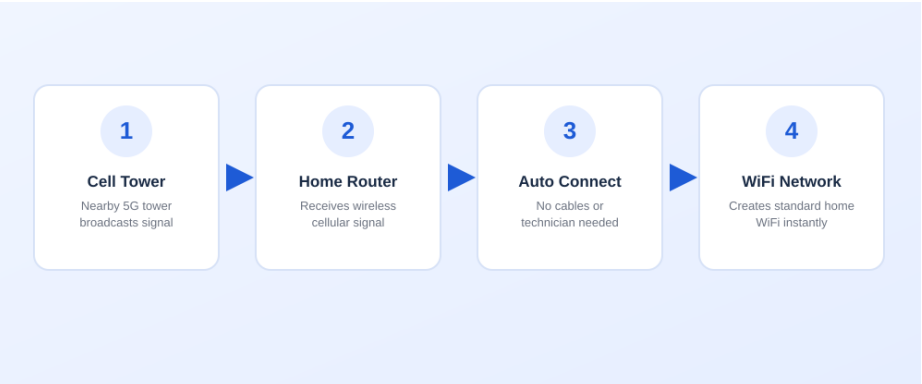
How 5G Home Internet works — from cell tower to home router to automatic connection to WiFi network
Why This Matters More Than It Sounds
The simplicity isn’t just a nice-to-have it solves a real problem for a specific group of people. If you rent and move every year or two, committing to a wired installation (and potentially an early termination fee if you need to cancel mid-lease) is a real hassle. With 5G Home, you can often take the router with you to your next address and simply check whether 5G coverage is available there too.
It’s also a genuine option for homes where running fiber or cable simply isn’t feasible older buildings where wiring is difficult, certain rural areas with decent cell coverage but no wired infrastructure, or situations where you need internet set up fast and can’t wait for a scheduled installation window.
The Speed Reality
5G Home typically delivers 100–300 Mbps, which comfortably covers streaming, browsing, video calls, and most everyday household use. It’s not generally competitive with top-tier fiber or cable plans that push past 1 Gbps, but for a household of a few people doing normal internet activities, the difference is rarely noticeable in daily use.
The bigger variable is consistency. Because 5G Home relies on cellular signal strength, your actual speed depends heavily on how close you are to a tower and how congested that tower’s network is at any given moment. A home a few blocks from a strong 5G tower might get excellent, consistent speeds; a home at the edge of coverage might see more fluctuation throughout the day.
What 5G Home Isn’t Great For
Latency and consistency are the two things to be honest about. If you’re a competitive online gamer, the connection’s responsiveness generally won’t match a wired fiber connection cellular networks introduce more variability than a dedicated fiber line. Similarly, if your household has multiple people doing simultaneous heavy tasks (large uploads, 4K streaming on several devices, video calls all running at once), a wired connection will handle that more predictably.
It’s also worth checking real coverage at your specific address rather than assuming based on general 5G marketing maps, since actual home internet performance depends on signal strength at your exact location, not just general cellular coverage.
5G Home vs. Fiber vs. Cable
| 5G Home | Fiber | Cable |
Installation | Self-install, minutes | Professional, can take days | Often same-day or self-install |
Typical speed | 100–300 Mbps | 300 Mbps – 8 Gbps | Up to 2 Gbps |
Contract | Often none | Often none | Sometimes required for best price |
Best for | Renters, simple setups, backup connections | Heavy users, remote work, gaming | Budget-conscious, wide availability |
If your household’s needs lean toward fiber internet heavy upload use, competitive gaming, multiple people working from home that’s still the stronger choice where it’s available. If you want the absolute simplest setup possible and your usage is more moderate, 5G Home is worth serious consideration.
A Good Backup Option, Too
One use case that doesn’t get talked about enough: 5G Home as a backup connection. If you’ve ever lost internet during a storm or a provider outage at an inconvenient moment, having a 5G router as a fallback even an inexpensive one you only activate when needed can keep you connected for important calls or deadlines while your primary connection gets fixed.
Is 5G Home Internet Available At Your Address?
Coverage depends entirely on cellular tower placement and network capacity in your specific area, and it varies by carrier (primarily T-Mobile and Verizon currently offer dedicated 5G Home plans). The best way to know for sure is to check directly, since national coverage maps don’t always reflect real performance at a specific address.
Fast Communications doesn’t currently carry 5G Home Internet as one of our dealer partnerships our focus is fiber, cable, and satellite internet, where we can offer the same pricing as ordering direct from the provider. But if you’re trying to figure out whether 5G Home is the right call versus one of those options, we’re happy to help you think it through.
The Bottom Line
5G Home Internet is a genuinely useful option for the right household renters, people who want the simplest possible setup, or anyone in a spot where wired options are limited. It’s not trying to be the fastest connection available; it’s trying to be the easiest. For households with heavier internet demands, a wired fiber or cable connection will still generally serve you better.
Not sure which connection type fits your situation? Call (888) 841-5332 and we’ll help you compare 5G Home against the fiber, cable, and satellite options actually available at your address or enter your address on our homepage to see your options instantly.